How to Save Recipes from KakaoTalk (Chats, Open Chats & Channel Posts)
Your mum’s doenjang jjigae recipe is buried under 2,000 KakaoTalk messages and three dozen emoji reactions.
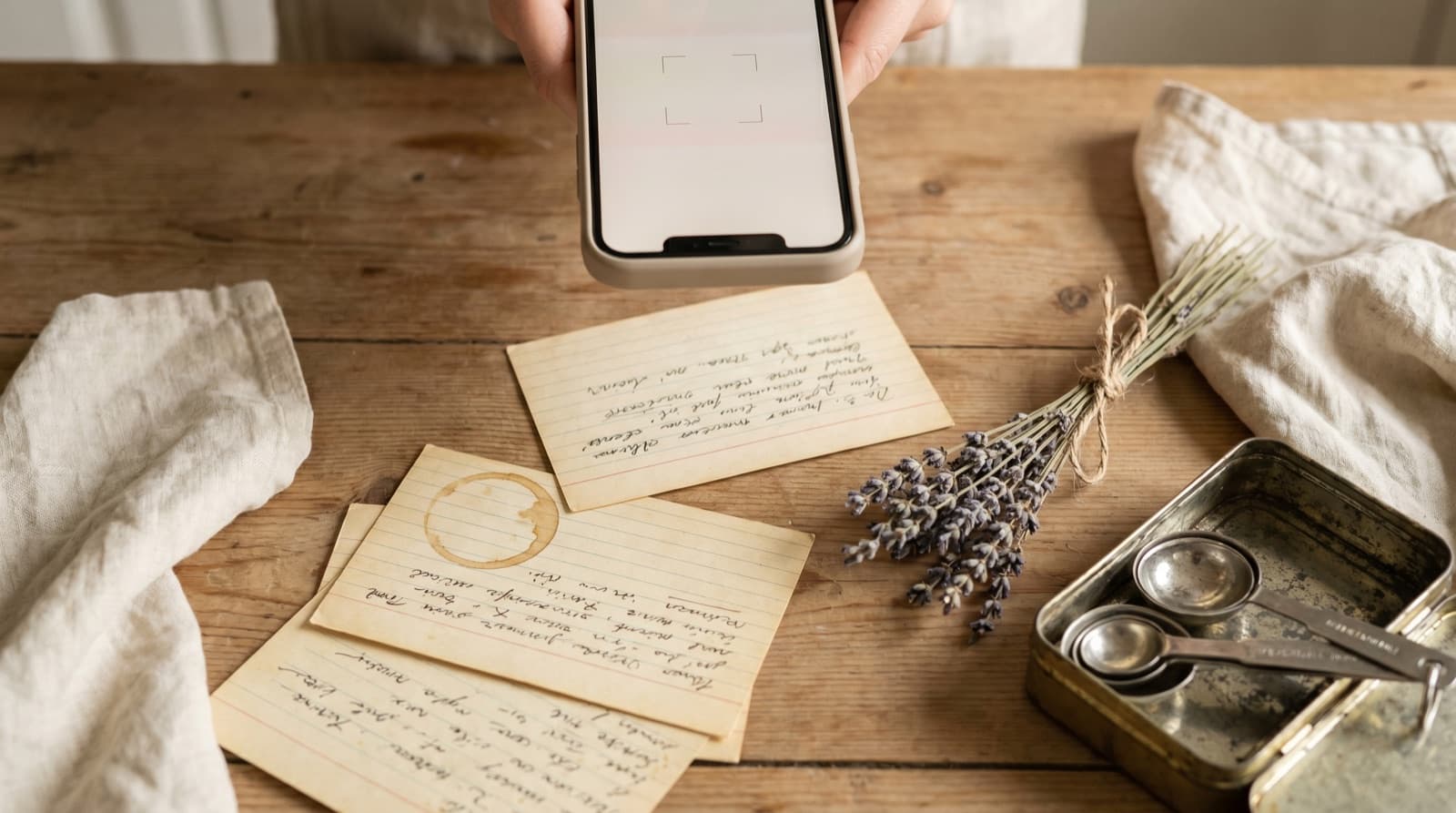
KakaoTalk is used by over 97% of South Korean smartphone users — roughly 53 million monthly active users — and for many Korean households it’s the primary communication channel for everything from work to family to meal planning. That means it’s also where home recipes get shared, forwarded, admired, and immediately buried under a hundred messages about something else entirely.
The core problem is familiar if you’ve ever tried to find a recipe in WhatsApp or Line: a messaging app designed for real-time conversation is a terrible archive. But KakaoTalk has a few specific features — Keep, Channels, Open Chat — that change the approach slightly from other platforms. Here’s how to handle each.
Why KakaoTalk Loses Your Recipes
The structural issues with KakaoTalk as a recipe store:
- Korean family group chats are extremely active. A Korean family KakaoTalk chat can generate hundreds of messages a day: news articles, photo updates, forwarded videos, weather commentary. A recipe posted on Monday is 500 messages deep by Thursday.
- Search only works within individual chats. KakaoTalk’s search is per-conversation. If you remember the recipe but not which group it arrived in — the family chat, the cooking Open Chat, or a one-on-one with your aunt — you have to search each one separately. There’s no global message search.
- Search doesn’t index images. If the recipe was shared as a photo of a handwritten card, a screenshot from Naver Blog, or a photo from a Korean cookbook, KakaoTalk’s search won’t find the text inside the image.
- Message history disappears after reinstalls. If you reinstall KakaoTalk, switch phones, or don’t have a backup configured, older message history may not be recoverable — KakaoTalk keeps some history server-side, but not all of it, and restoring across devices is not guaranteed.
- Keep has no export. KakaoTalk’s Keep feature is a good emergency save, but it’s a KakaoTalk-only silo — no export, no ingredient search, no scaling. If KakaoTalk changes how Keep works, or if you migrate away from the platform, your saved collection moves with it.
How to Save a Recipe from a KakaoTalk Group Chat
For a typed recipe in a message
- Find the message in the group chat. If it’s recent, scroll up. If it’s older, tap the magnifying glass at the top of the conversation and search for a word from the recipe (a key ingredient, the dish name, or the sender’s name).
- Long-press the message bubble. A context menu appears. Tap the copy icon (two overlapping rectangles) to copy the full message text to your clipboard. On some versions of KakaoTalk, you can also tap “Keep” (the bookmark icon) to save a copy to My Keep as a staging step.
- Open Pantree and tap the plus icon to start a new recipe.
- Paste the text. Pantree parses unstructured text and separates ingredients from method steps. “두부 1모 (tofu, 1 block)” becomes a structured, scalable ingredient. If the recipe spans multiple messages, copy and paste each one in sequence, then tidy up duplicates.
- Add a title, review and save. The recipe is now searchable by ingredient, scalable for any serving size, and not buried in a chat that may have another 10,000 messages in it by next month.
For a recipe posted as a photo
- Tap the photo in the conversation to open it full-screen. Tap the download icon (downward arrow, bottom-left) or long-press and choose “Save to Gallery” — this puts a copy in your phone’s photo library.
- Open Pantree, tap the plus icon, and choose the photo import option.
- Select the saved photo. Pantree uses OCR to read the recipe text from the image, handling typed recipes, printed cards, Naver Blog screenshots, and handwritten notes. KakaoTalk compresses images in group chats, so very low-resolution photos may need a small manual correction — but it’s still faster than retyping.
- Review and save.
Using KakaoTalk Keep as a Staging Area
KakaoTalk Keep (킵) is the right place to put recipes the moment you spot them, even if you don’t have time to process them yet. Long-press any message, tap the Keep icon (bookmark), and a copy is stored in My Keep (your profile → Keep). The original can be deleted from the group, the group can be disbanded, the sender can delete their account — your Keep copy survives all of this.
Then, once a week, open My Keep and move anything recipe-shaped into Pantree. This two-step approach works because it decouples “I should save this” (which happens in a split second while you’re reading the family chat) from “I should process this properly” (which needs two focused minutes at a desk). The result is a Keep inbox that stays manageable and a Pantree library that grows steadily without requiring attention in the moment.
What Keep doesn’t solve: recipes you want to access on a non-KakaoTalk device, ingredient search across your whole collection, scaling for a different serving size, or shopping list generation. Those only get solved by moving the recipe somewhere that isn’t KakaoTalk.
Saving Recipes from KakaoTalk Channels
KakaoTalk Channels (카카오채널, formerly Plus Friends) are used by food brands, supermarket chains, restaurant groups, and recipe creators to send content to followers. Major Korean food manufacturers like CJ CheilJedang (the company behind Bibigo), Ottogi, Nongshim, and Maeil Dairies post seasonal recipes and cooking tips through their Channels.
The problem: Channel posts behave like a one-way chat history. They scroll out of view, there’s no save-and-search function, and there’s no way to export Channel content. Some Channel posts include links to the brand’s website or the Kakao Recipe platform — if a URL is attached, copy it and import it into Pantree directly. For recipes posted as text or images in the Channel feed itself, use the same approach as a group message: long-press to copy the text, or save the image to your gallery and import via OCR.
One practical move: if you follow a food brand or recipe creator on a KakaoTalk Channel and they post regularly, treat each recipe post as a notification to process within the same day. Recipes are easiest to rescue when they’re at the top of the feed.
Saving Recipes from KakaoTalk Open Chat
KakaoTalk Open Chat (오픈채팅) is a public community feature where anyone can join without being contacts first. Cooking-focused Open Chats are active and well-populated — Korean home cooking communities, regional cuisine groups, bento and meal-prep communities, diet and nutrition chats. They share tested, home-cook-level recipes you won’t find on a commercial recipe site.
Open Chat message history behaves identically to a group chat: it scrolls away, isn’t searchable by ingredient, and you lose access if the community closes or the admin removes you. Any recipe worth keeping from an Open Chat should be saved using the same workflow as a regular chat message.
One useful feature many Open Chats use: pinned messages. Active communities pin foundational recipes, community rules, and particularly popular posts at the top of the chat. Check pinned messages first before scrolling — the pinned recipes are usually the ones the community has tested and considers reliable.
What About Links to Naver Blog or Kakao Recipe?
Many Korean recipes are shared as links to Naver Blog, Naver Recipe, or the Kakao Recipe service rather than typed directly into the chat. If the message contains a URL, tap it to open in the browser, then copy the full URL and paste it into Pantree’s URL import field. Pantree will fetch the page and extract the recipe — title, ingredients, method — into a structured card. This is faster than copy-paste and captures the full recipe even if it’s long.
Note that some Naver Blog posts are behind a login requirement for non-Korean accounts. If Pantree can’t access the page, the fallback is to open the link on your phone, manually copy the recipe text, and paste it into Pantree.
Related Guides
If recipes also arrive via other messaging platforms, we’ve written specific guides for WhatsApp, Telegram, WeChat, Line, Signal, and SMS and Android Messages. For recipes spotted on short-video platforms, the TikTok guide and YouTube guide cover the same underlying challenge in a different format.
Frequently Asked Questions
Can I search for a recipe inside a KakaoTalk group chat?
KakaoTalk has a search function inside each chat — tap the magnifying glass icon at the top of the conversation. It searches message text and can filter by sender, which is useful if you remember who shared the recipe. The search doesn't index image content, voice messages, or file attachments, only typed text. For older messages, the results depend on how much chat history is loaded on your device — after reinstalling the app or switching phones, older messages may not appear even if they're on the server. Use it as a first step, but don't rely on it for recipes from more than a few weeks ago.
What is KakaoTalk's Keep feature and can I save recipes there?
KakaoTalk has a 'Keep' feature (킵) where you can store messages, photos and files from any chat. Long-press a message bubble and tap the Keep icon (bookmark shape) to save a copy. Keeps are stored in My Keep (accessible from your profile) and persist even if the original message is deleted from the group chat. This is better than nothing — it's safe from group deletion and you can access it without scrolling through the chat. The problem is Keep is KakaoTalk-only: no export, no ingredient search, no scaling, and if KakaoTalk changes the feature, your collection is at risk. Use Keep as a quick staging area, then process recipes into Pantree for a permanent, portable copy.
How do I save a recipe posted as a photo in KakaoTalk?
Tap the photo in the conversation to open it full-screen, then tap the download icon (downward arrow) or long-press and choose 'Save to Gallery' — this puts a copy in your phone's photo library. From there, open Pantree, tap the plus icon, and use the photo import option. Pantree uses OCR to extract recipe text from the photo, handling typed recipes, printed recipe cards, and even handwritten notes. KakaoTalk compresses images in group chats, so very low-resolution photos may need a small manual correction after OCR, but it's still much faster than retyping everything.
What about recipes from KakaoTalk Channels?
KakaoTalk Channels (카카오채널, formerly KakaoTalk Plus Friends) are used by food brands, restaurant chains, and recipe creators to send content to followers. Major Korean food brands like CJ CheilJedang, Ottogi, and Maeil Dairies post recipe content through Channels. The issue is the same as other messaging platforms: Channel posts scroll out of view, there's no save-and-search function, and there's no way to export Channel history. Some Channels include links to their website or the Kakao Recipe service — if a URL is attached, copy it and import it into Pantree directly. For text or image recipes posted in the Channel chat, use the same copy-or-save approach as a group message.
How is saving recipes from KakaoTalk different from WeChat or Line?
The core challenge is identical across all three: recipes arrive in a chat format that wasn't designed to be a recipe archive, and they scroll away. The specific mechanics differ slightly. KakaoTalk's Keep feature is similar to Line Keep — both are good staging areas but lack export. WeChat has a Favourites (收藏) feature with a slightly different interface. KakaoTalk searches within individual chats rather than across all chats, which matters if a recipe arrived in a family group chat you're not sure which one. The import-to-Pantree workflow is the same regardless of which platform the recipe came from.
What about recipes shared in KakaoTalk Open Chats?
KakaoTalk Open Chat (오픈채팅) is a public community feature — anyone can join without being contacts, which makes it popular for interest-based groups including cooking communities. Korean home cooking Open Chats, regional food communities, and diet and meal-prep groups all share recipes. Open Chat message history behaves the same as a group chat: it scrolls, isn't searchable by ingredient, and you lose access if the community closes or the admin removes you. Any recipe worth keeping should be saved using the same workflow as a regular chat message. Many Open Chats also pin foundational or popular recipes at the top — check the pinned messages first before scrolling.
Get your KakaoTalk recipes somewhere permanent.
Pantree turns pasted or photographed recipe text into a structured recipe card with a built-in shopping list — searchable, scalable, and not locked inside any single app.
