How to Scale a Recipe Up or Down Without Ruining It
Doubling a recipe rarely means doubling everything. Here’s the math, the exceptions, and the six ingredients that wreck dinner if you treat them like the rest.
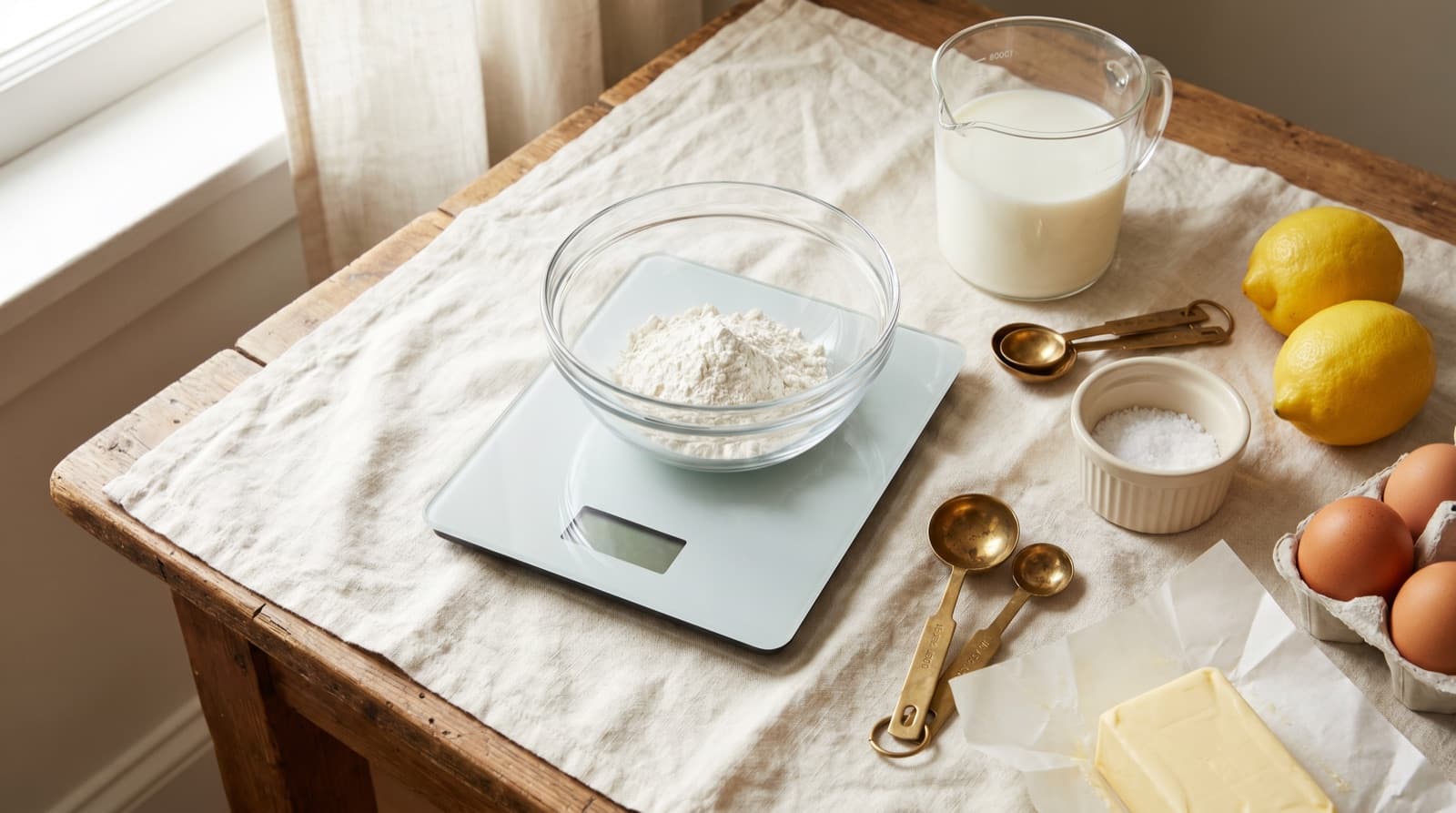
You have a recipe that feeds four. Six people are coming. The obvious move — 1.5x everything — gives you a dinner that’s mysteriously over-salted, the pasta sauce reduced to a paste, and a cake that domed in the middle and sank at the edges. What went wrong was the maths. Or rather, the assumption that the maths was uniform.
Scaling a recipe is one of those kitchen skills that looks like arithmetic and is actually closer to chemistry plus geometry. Doubling the flour doubles the flour. Doubling the cayenne doubles something more dangerous. Doubling the pan you cook the lot in — because you didn’t — changes the cooking entirely. Here’s how to scale a recipe up or down so it actually tastes like the recipe.
Why “Just Double It” Falls Apart
Recipes are a balance between three independent things: ingredient ratios, total volume, and cooking dynamics (heat, time, surface area). Linear scaling assumes all three move together. They don’t.
- Ratios mostly do scale linearly. Flour to sugar to fat to liquid stays the same regardless of batch size, and this is the part where the maths is uncomplicated.
- Perception doesn’t. Salt, heat and strong aromatics compound on the palate when scaled in volume — a dinner that’s twice as big at the same seasoning per gram tastes noticeably saltier and hotter than the original.
- Heat geometry doesn’t either. A doubled stew in the original pot has the same surface area for evaporation but twice the volume. It steams instead of simmers, reduces too slowly, and the meat comes out tougher.
Once you separate those three variables, scaling becomes a system rather than a guess.
The Six-Bucket System
Every ingredient in a recipe falls into one of six buckets, and each bucket scales differently. Print this somewhere or save it as a note — ninety percent of scaling errors come from putting an ingredient in the wrong bucket.
- Bulk ingredients (linear). Flour, sugar, vegetables, meat, stock, oil, dairy. Multiply by the factor. Weigh in grams whenever you can — volume measurements compound errors at high multipliers.
- Salt and strong spices (~0.75 of factor). Salt, cayenne, cumin, garlic powder, smoked paprika, dried chili. Use about three-quarters of the multiplier. Doubling? 1.5x. Halving? 0.4x (slightly more than half). Always taste and adjust at the end — this bucket is the one you finish, not commit to.
- Gentle aromatics (~0.85 of factor). Dried herbs, vanilla, citrus zest, oregano, thyme. Closer to linear, but still ease off slightly. Fresh herbs scale linearly because they’re gentler — mostly water.
- Leaveners (~0.9 of factor). Baking powder, baking soda, yeast. Scale just under linear. A 2x cake recipe gets 1.8x leavener; a 0.5x cake recipe gets 0.55x. Going straight linear here is how cakes dome and split.
- Eggs (by weight, not count). A large egg is roughly 50g out of the shell (30g white, 20g yolk). For awkward fractions like “1.5 eggs” beat one, weigh out 25g, and refrigerate the rest for tomorrow’s scrambled.
- Cooking time and pan size (don’t scale linearly). See below. This is the one most people forget.
The Cooking-Time Problem Nobody Warns You About
Heat travels through volume in three dimensions, not through the ingredient list. A doubled roast takes about 50% more time, not twice as long. A doubled stew in a wider pan takes the same time as the original; in the original pot it takes 30–40% longer and turns into something else.
The working rules:
- Roasts and braises: 1.25–1.5x time for doubled weight, at the same oven temperature. Use a probe thermometer, not the clock.
- Stews and sauces: Use a pan one size up. If you can’t, split between two pans. Same temperature, similar total time — the wider surface area lets evaporation keep up with the bigger volume.
- Baked goods: Same temperature, check earlier (~15% sooner) for halved portions, later (~15% longer) for doubled portions in a bigger tin. If you bake the same volume in two smaller tins, the time is the same as the original.
- Pan-fried things: Don’t double in the same pan. Two batches in the original pan beats one crowded batch every single time — crowded pans steam, they don’t brown.
The single biggest scaled-recipe failure is “the doubled recipe in the same pot”. Buy a bigger pot, use two pans, or cook in two rounds.
Baking Is a Special Case
Cooking forgives scaling errors. Baking remembers them. A 5% error in flour weight is invisible at 1x and obvious at 4x — cakes crack, breads collapse, biscuits spread.
For baked goods, three rules sit above the others:
- Weigh, don’t measure by volume. A cup of flour ranges from 120g to 160g depending on how it’s scooped. At 1x that’s a wobble. At 3x it’s a different recipe. The same logic we made the case for in how to read a recipe like a pro applies double when you’re scaling.
- Round eggs to whole numbers, or weigh. For 1.5x of a 2-egg recipe, use 3 eggs and add a touch more liquid; for 0.75x of a 4-egg recipe, use 3 eggs. Where the maths is fiddly, weigh.
- Hold baking time roughly constant if pan depth is constant. A doubled cake in a wider, same-depth tin bakes in about the same time as the original. A doubled cake in a deeper tin takes significantly longer and is much harder to get right — better to bake two thinner layers.
The Phone Does the Boring Bit
The arithmetic part of scaling — converting 1⁄3 cup of butter to 2.5 tablespoons, or 200g flour to 300g for 1.5x — is exactly the work a recipe-keeper app should be doing for you. In Pantree you change the serving count and the ingredient list re-scales by weight automatically. The judgement calls — pulling salt back, switching to a bigger pan, reading the cake at 35 minutes instead of 40 — are still yours, but the maths stops eating your evening.
It pairs with the rest of how a digital library earns its keep: cooking from what you already have, planning the week with a meal plan that survives Wednesday, and not throwing food away because the shopping list scales with the recipe. Six guests instead of four becomes one tap, not a sticky-noted page of crossed-out quantities.
The Quick Sanity Check Before You Cook
Before any scaled recipe leaves the bowl for the pan, run this 30-second check:
- Is the pan one size bigger (up-scaling) or smaller (down-scaling) than the original called for? If not, fix it now.
- Is the seasoning at three-quarters of the linear scale, not full? Salt is the easiest to over-add and the hardest to claw back.
- Have eggs and leaveners been weighed or rounded sensibly?
- Have you set a timer for the original cooking time as a check-in point — not a finishing point — and got a thermometer or skewer ready?
That check survives the rest of the recipe. Scaling stops being a high-wire act and starts being maintenance.
The Point
Scaling a recipe is the difference between cooking for the family you actually have and cooking the recipe you actually wrote down. Most people’s recipes are stuck at four because doubling them is a small disaster — the seasoning’s off, the timing’s wrong, and the pan’s crowded. With a system, scaling is boring. And boring, in the kitchen, is usually the goal.
Get the buckets right, weigh the things that matter, use a bigger pan, taste before you commit. The recipe that fed four for a decade quietly starts feeding six, or two, or twelve — and tastes the same every time.
Frequently Asked Questions
Can you just double every ingredient in a recipe?
No. Most main ingredients (flour, sugar, vegetables, meat, stock) scale linearly, but salt, spices, leaveners, fat, and cooking times do not. As a rule, double the bulk and start with 1.5x the salt and spices, taste, and adjust. Halve leaveners more aggressively than you'd expect — baking powder and soda go off-balance quickly when scaled.
What's the safe rule for scaling salt and spices?
Start at 1.5x when doubling, 0.75x when halving, and taste before committing. Strong spices (cayenne, cumin, garlic) compound their punch when scaled straight; gentler ones (paprika, oregano) tolerate near-linear scaling. Always under-season the pot and finish to taste — it's harder to claw back over-seasoned food than to add more.
Why doesn't cooking time scale with the recipe?
Heat travels through volume, not through quantity on a list. A 1 lb roast and a 2 lb roast cooked at the same temperature don't take twice as long — usually about 50% more. A doubled stew in a wider pot might take the same time; a doubled stew crammed into the original pot takes longer and steams instead of simmers. Scale by volume and pan size, not by ingredient list.
How do I scale a baking recipe without ruining it?
Baking is the riskiest scaling job because it's chemistry. Use weights, not cups — small volume errors compound when scaled. Scale flour, sugar, fat, and liquid linearly. Scale eggs in increments of one (round to the nearest whole egg, or use weight: roughly 50g per large egg). Scale leaveners (baking powder, soda, yeast) slightly under linear — 1.8x when doubling is safer than 2x. Bake at the same temperature but check earlier for smaller portions and later for larger ones.
What's the easiest way to halve a recipe with awkward measurements?
Convert everything to weight or to teaspoons/tablespoons first, then halve. A 3-egg recipe halved becomes 1.5 eggs — beat one egg, weigh half (~25g), and use that. A 1/3 cup of flour halved is just under 3 tablespoons. Most kitchen disasters come from rounding aggressively because the math felt awkward — a kitchen scale solves it in 10 seconds.
Does a recipe-keeper app actually scale recipes properly?
A good one scales the ingredient list linearly and lets you adjust salt, spices, and cooking time manually. The math part — turning 1 1/4 cups into 5/8 cup, or 200g into 300g for 1.5x — is exactly the boring work a phone is for. What no app can do is judge: it can't tell you that the doubled chili needs only 1.5x cayenne, or that the halved cake should bake five minutes shorter. That's still you.
Scale the recipe, not the stress.
Pantree re-scales any recipe by serving count, in weights, and updates the shopping list with it. Free on the App Store.
