Pantry Organization Ideas That Actually Stick
Most pantry organization advice is for show, not for cooking. Here are 9 ideas that survive a real household, the ones that mean you stop buying duplicates and finish what you have.
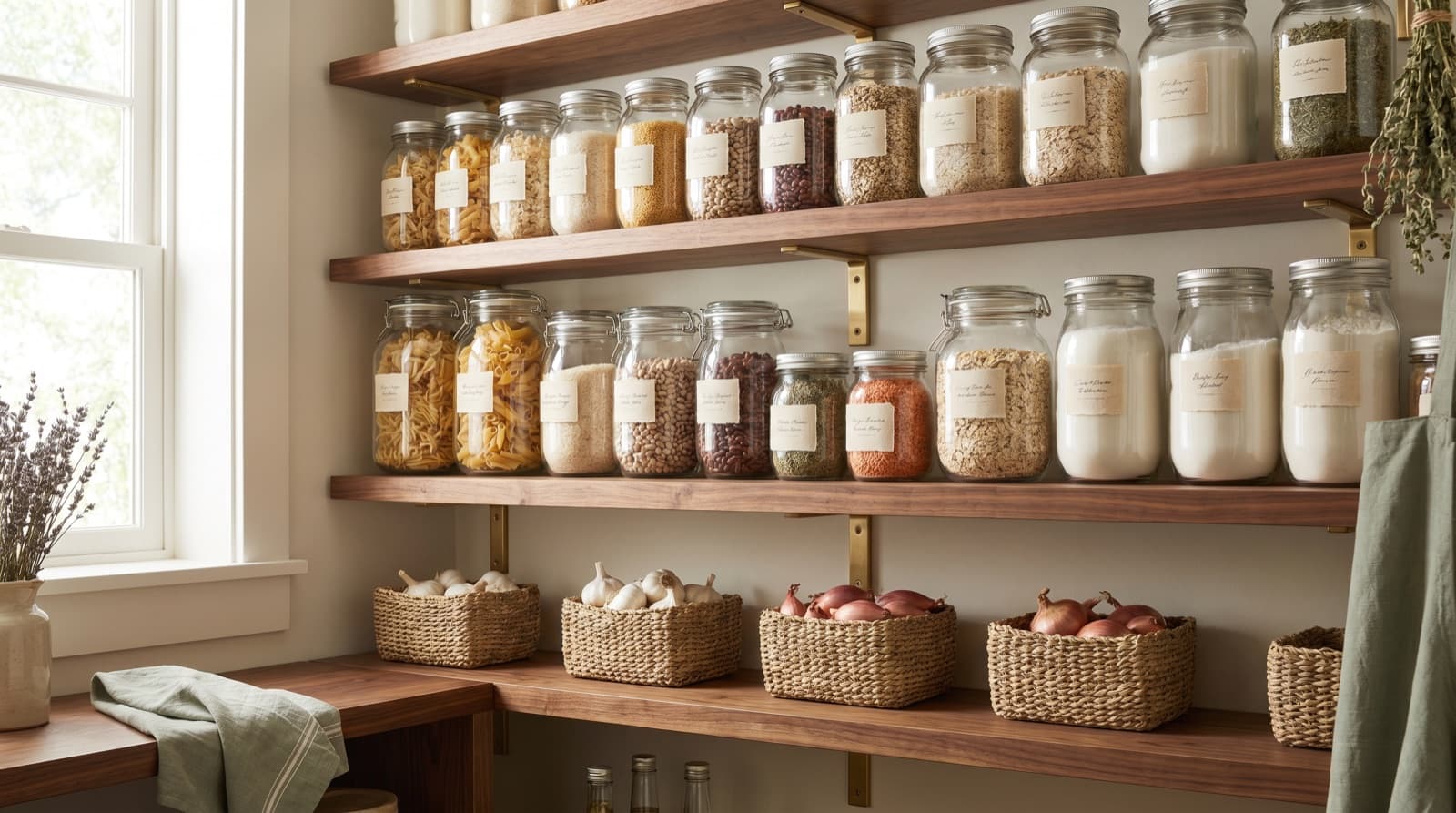
Pinterest pantries are works of art. They are also unrelated to real life. The version where every jar is hand-labelled in calligraphy and the chickpeas are arranged by colour is great if your job is curating shelves. If your job is cooking dinner on a Tuesday, the goal is different: you need a pantry where you can find things, where you don’t buy duplicates, and where stuff gets used before it expires.
Here are 9 organization ideas that hold up across a real household, beauty optional.
1. Empty the whole thing first
Before any reorganization, take everything out. All of it. The point isn’t aesthetic; it’s that you can’t see what’s actually there until it’s out. Most people doing a “pantry sort” without emptying are just shuffling things around the same shelves.
What you’ll find: at least three things expired by years, two duplicates, one bag of flour you bought for a recipe in 2019, and a mysterious bottle of fish sauce your partner swears they’ve never seen.
2. Sort by category, not by container
Group everything into 6 working categories:
- Cooking fats and oils, olive oil, neutral oil, sesame oil, vinegar
- Cans and jars, tomatoes, beans, tuna, sauces
- Dry grains and pasta, rice, pasta, oats, quinoa, lentils
- Baking, flour, sugar, baking powder, vanilla
- Snacks, nuts, crackers, dried fruit
- Spices & aromatics, whole and ground spices, dried herbs, salt
Don’t organize by container shape (“all the jars together”). Organize by what gets used together. The fish sauce sits with the soy sauce, even if one’s glass and one’s plastic.
3. Eye-level for daily use, lower or higher for occasional
Put the stuff you reach for every day at eye level: olive oil, salt, the spice blend you cook with weekly, your rice and pasta, the tinned tomatoes. Less-used things (festive spices, that one speciality vinegar) go on lower or higher shelves. This sounds obvious, but most pantries are sorted by accident-of-arrival, not by frequency of use.
4. Decant only what you actually use frequently
Decanting all of your dry goods into matching jars looks beautiful on Instagram and is, for most people, overkill. Decant the things you use weekly: rice, pasta, oats, flour, sugar, maybe lentils. Skip the bag of polenta you bought once. Decanted goods need space, jars cost money, and the visual return on a half-decanted pantry is the same as a fully decanted one.
Critical rule: when you decant, transfer the best-before date with a small label. Otherwise you’ve lost the only piece of information that mattered on the original packaging.
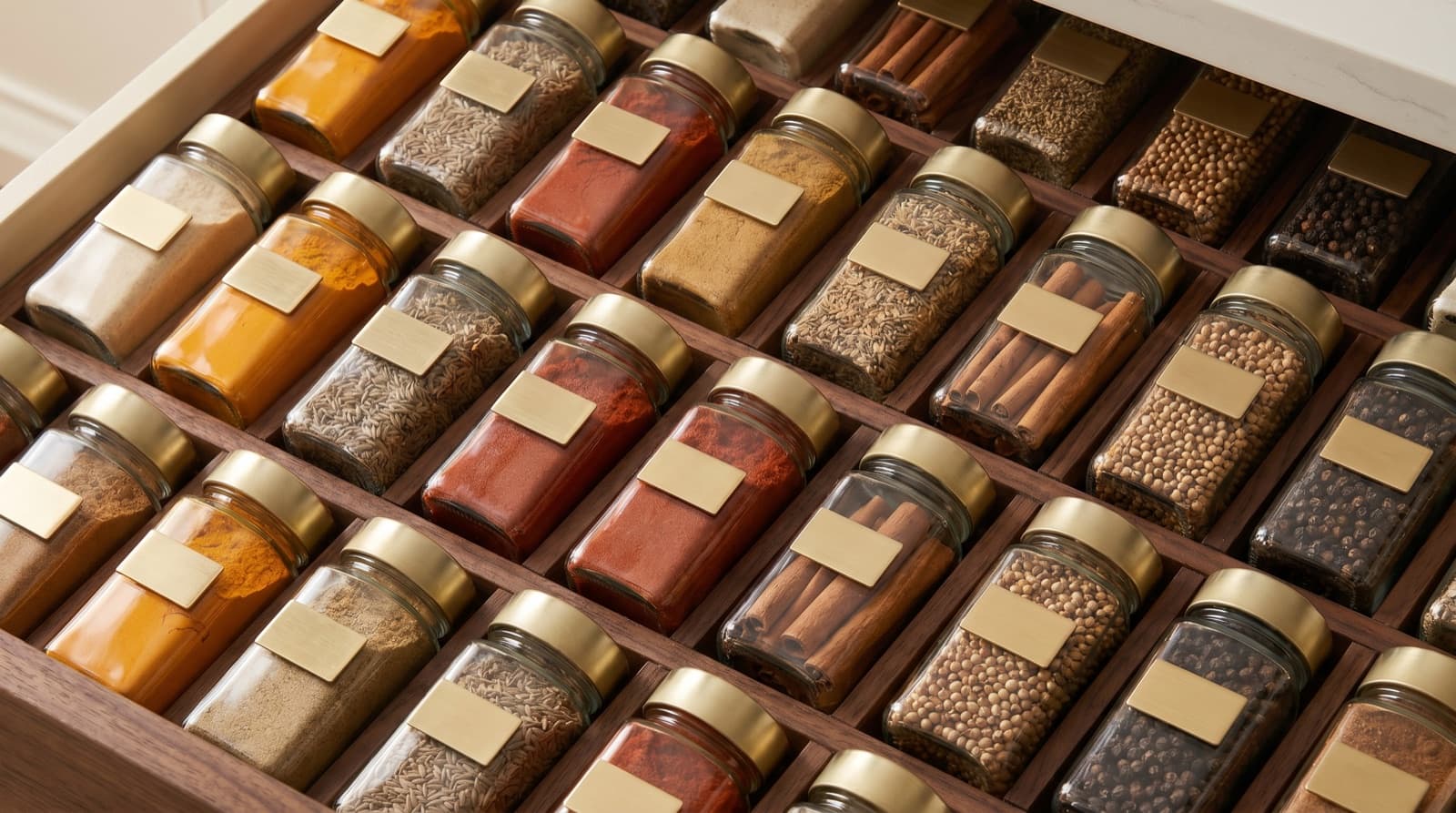
5. Use clear containers (so you can see when you’re running low)
The single biggest reason pantries lie to you is opaque packaging. You think there’s plenty of rice; there’s a tablespoon in the bottom of the bag. Clear glass or clear plastic eliminates this, at a glance you can see what’s low and what’s full.
6. Tiered shelves and risers double your visible surface
A spice rack that’s three rows of risers gives you 15 spice jars visible at once instead of 5 buried behind the front row. Same logic for tinned goods, a riser turns a stack of 6 cans into 6 visible cans. Tiered shelves are the cheapest pantry upgrade with the biggest functional return.
7. Lazy Susans, narrow drawers, door storage
Three of the highest-leverage pantry tools:
- Lazy Susan / turntable in any deep corner cupboard. Things at the back stop being abandoned.
- Narrow pull-out drawer for the gap between the fridge and the wall. The only place baking sheets actually fit.
- Over-the-door spice rack on the inside of the pantry door. Frees up a full shelf, makes spice selection instant.
8. Label dates, not contents
If everything’s in clear containers (idea 5), you can see what’s inside. The label that genuinely changes behaviour is a small “best by” date sticker. This is the information you lose when you decant, and it’s the information that prevents the slow accumulation of expired things at the back of the shelf.
9. Keep a digital inventory you can check from a shop
This is the idea that distinguishes a pantry that looksorganised from one that functions organised. The single biggest grocery-bill leak in most households is duplicate-buying , the third tin of chickpeas, the second tub of yoghurt, the two bags of self-raising flour you didn’t know you had.
The fix is an inventory you can check from your phone in the supermarket. We built Pantree partly for this, a digital version of your pantry with quantities and expiry dates, share-able with the rest of the household. Think of it as the inventory layer your physical pantry doesn’t have. For more on why this matters financially, see our post on how to save money on groceries.
The 5-minute weekly habit that holds it all together
Once a week, before grocery shopping, do a 5-minute pantry check:
- Quick visual scan of every shelf
- Move anything within 3–4 days of expiry to eye level (use it up first)
- Note what’s genuinely low (not what you think is low)
- Update your shopping list to match the actual gaps
This is the habit that keeps the organisation from drifting back to chaos. Without it, every shop adds a layer of chaos; with it, every shop reinforces the system.
What to skip
Things that look great on Pinterest and don’t pay back:
- Decanting every single thing into matching jars. Decant the daily-use staples; leave the rest.
- Calligraphy labels. A label maker is fine. Use the time you’d spend hand-lettering on actually cooking.
- Fancy organising tools you saw once. The over-engineered drawer dividers, the bamboo lazy susans, the custom-cut shelf liners. Buy plain, work it for 3 months, and upgrade only what you actually use daily.
- Aspirational ingredients. A pantry organized around dreams (the truffle oil, the seven kinds of vinegar) instead of habits (the soy sauce, the olive oil, the rice you’ll cook tonight) is theatre.
The whole point
A pantry that works is a pantry where you can find what you have, stop buying what you already have, and finish what you bought. That’s it. Everything else is decoration. If you’re stocking from scratch, our 25 pantry staples list is the foundation; if you’re trying to actually cook from it, our framework on what to cook with what you have is the next step.
Frequently Asked Questions
How do I organize my pantry?
Start by emptying the pantry, throwing out anything expired, and grouping what's left into 6 categories: cooking fats and oils, cans and jars, dry grains and pasta, baking, snacks, and spices. Put the things you reach for daily at eye level, less-used things on lower or higher shelves. Decant only the dry goods you use frequently into clear containers (rice, pasta, oats, flour, sugar), you don't need every single thing in matching jars. Finally, keep an inventory you can check from your phone so you stop buying duplicates.
What containers are best for a pantry?
Clear, airtight, and stackable. The two most useful sizes: tall narrow ones (good for pasta, spaghetti, dried herbs) and wider square ones (good for rice, flour, sugar, oats). Glass with bamboo lids looks beautiful but is heavier and more fragile; clear plastic with silicone seals is more practical for daily use. You don't need all 20 jars to match, buy 8-10 for the staples you actually use.
How often should I clean out and reorganize my pantry?
A 5-minute weekly check (before grocery shopping) catches anything close to expiry. A full reorganization, empty everything, wipe shelves, throw out expired items, is worth doing twice a year. Most kitchens drift toward chaos in 3–4 months, so March/April and September/October are good seasonal anchors. The weekly check is more important than the seasonal deep-clean.
How do I organize a small pantry or limited shelf space?
Three principles: vertical space (use risers and tiered shelves to double your visible surface area), door-back storage (over-the-door spice racks free up shelf space), and ruthless edits (a small pantry can't carry the trendy ingredient you bought once for a recipe). Lazy Susans for corner cupboards, slim pull-out drawers for narrow gaps, and clear bins for grouped categories make small spaces feel ordered without needing more physical room.
Should I label my pantry containers?
Yes, but the label only needs to say what's inside. Calligraphy and twine aren't the point; legibility is. The single most useful additional label is a 'best-by' date written on a small sticker, especially for decanted dry goods (which lose their packaging date when transferred). A simple white label maker or chalk pen on a small chalk label is enough.
How do I keep my pantry organized once I've sorted it?
Two habits do 90% of the work: (1) put things back in the same place every time, and (2) check inventory before grocery shopping. The reason pantries drift back to chaos is that the decision of where something goes happens once during a big sort, then never again, every grocery shop after that, things get shoved wherever there's space. The cure is keeping each category's location stable and replenishing in place.
What's the difference between organizing and inventorying a pantry?
Organizing is physical (where things sit on the shelf). Inventorying is informational (knowing what's there without opening the cupboard). Both matter for different reasons, organization saves time when cooking, inventory saves money on groceries. The two reinforce each other: a well-organized pantry is easier to inventory, and a current inventory makes the disorganization that creeps in obvious. Apps like Pantree handle the inventory side digitally so you can check what's in your pantry from a shop without unloading the cupboard.
The inventory layer your pantry doesn’t have.
Pantree tracks what’s in your kitchen so you stop buying duplicates. Free on the App Store.
