Shelf-Stable Chic Meets the Math: Why 2026’s Quietest Pantry Trend Could Save You $2,913 a Year
The pantry-as-decor trend on your feed is real. The financial upside underneath it is bigger than anyone’s saying — but only if you fix the three bottlenecks that keep your groceries from becoming dinner.
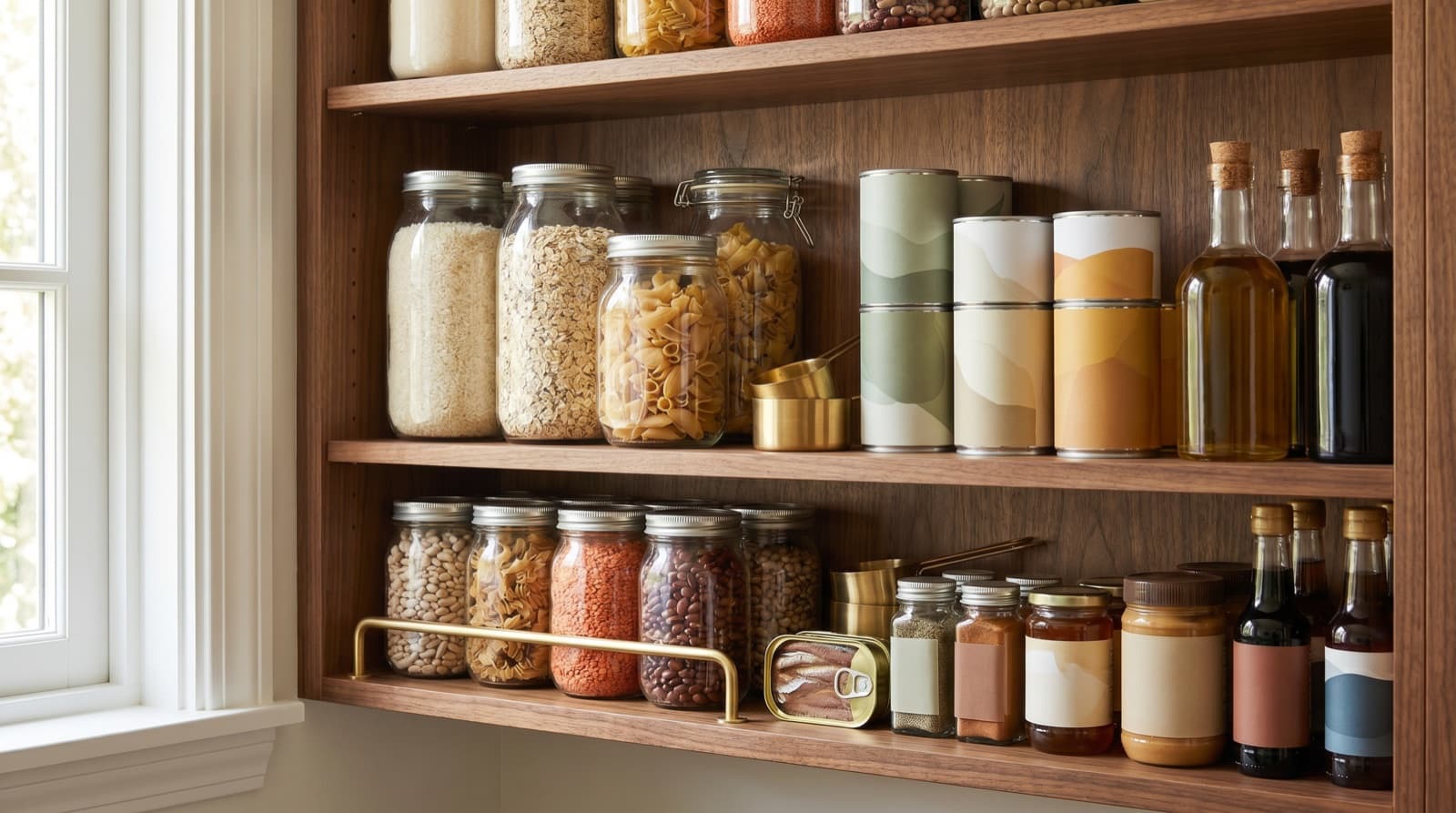
If you’ve spent any time on food TikTok this spring, you’ve watched the slow takeover of “Shelf-Stable Chic” — beans in glass jars, anchovies with collector-grade labels, pantries styled like wine cellars. Whole Foods and Parade both called it one of 2026’s defining food trends. Underneath the aesthetics is a quieter shift: frugality is no longer a confession, it’s a flex. Cooking the same $2 bag of lentils ten different ways is the new “I make my own sourdough.”
Here’s the part nobody’s putting on a moodboard.
The math hiding in your pantry
The EPA’s most recent consumer food-waste study puts the average American at $728 a year in food thrown away. Scale that to a household of four and you’re looking at $2,913 every twelve months — roughly one mortgage payment, or a one-way ticket to Tokyo, vaporised into the bin.
US households alone are responsible for 30–40% of all national food waste — a bigger share than restaurants, retailers, or farms individually. The fancy jars look great. They do not, by themselves, fix this.
Why the trend doesn’t fix the problem
A styled pantry is a storage trend. Food waste is a flow problem. The food you bought, the recipes you saved, and the meals you actually cooked this week are three separate streams of information, and for most households they never touch.
That’s the disconnect we keep seeing:
- You bought celery on Saturday because you were going to make that soup.
- The soup recipe is somewhere in a Reels save.
- The celery is now soft.
- You buy more celery on Friday “just in case.”
The aesthetic doesn’t break this loop. Visibility does.
The three bottlenecks (and how to actually fix them)
Bottleneck 1: You don’t know what you have
If you can’t see your pantry without standing in front of it, you’ll re-buy. Every time.
The fix isn’t a stricter shopping list — it’s a living inventory. A photo of a receipt should be enough to update what’s in your kitchen. The moment a half-bag of dried chickpeas drops out of memory, it drops out of your dinner rotation.
Pantree’s receipt scanner parses a grocery receipt in a few seconds and adds the items to your pantry with sensible expiry estimates. The half-bag of chickpeas stays visible until you cook it.
Bottleneck 2: Your recipes are scattered across four apps
The global recipe-organizer market hit $1.25B in 2024 and is projected to nearly double by 2029 — which is a polite way of saying everyone has this problem. Your saves are on Instagram. Your screenshots are in Photos. Your “I’ll try this” links are in Notes. The cookbook on the shelf has a sticky note on page 84 that you’ve forgotten about.
A recipe you can’t find is a recipe you don’t cook. A recipe you don’t cook is groceries you’re wasting.
The fix: one place for every recipe, regardless of where it came from — pasted from a link, shared from Instagram, photographed from a cookbook, or typed in from your grandmother. The format of the source shouldn’t matter. The retrieval should. Our guide on what to cook with what you have walks through this in more depth.
Bottleneck 3: Your shopping list lives in your head
When the list isn’t written down, two things happen: you forget what you needed, and you buy what you already have. Both ends of that bleed money.
The fix is mechanical — not motivational. When a recipe wants two cups of stock and your pantry only shows one, the missing cup should hit your shopping list without you doing anything. Friction is the reason good intentions become wilting parsley.
A 20-minute Sunday reset that actually compounds
Try this once. If it sticks, you’ve quietly bought yourself back ~$50 a week.
- Photograph last week’s receipt. Push it into your pantry inventory.
- Open the recipe you saved on Wednesday and forgot about. Just one. Mark it as “this week.”
- Let the app diff the recipe’s ingredients against your pantry. Whatever’s missing goes to the shopping list.
- Glance at expiry nudges. Two or three items hitting the edge? Those become tonight’s “use it up” dinner — not Friday’s compost.
That’s the whole loop. Inventory → recipe → diff → cook. The “Shelf-Stable Chic” jars get to keep their jobs as decor. The savings come from closing the gap between the three streams. (If reducing waste is your bigger goal, our deep-dive on how to stop wasting food covers seven supporting habits.)
The 2026 trends that all lean on this
Look at what’s climbing in recipe search this year — cabbage steaks, bean-forward dinners, high-fiber bowls, fermented-at-home, “elevated pantry staples” (see the Whole Foods 2026 trend report). They share a common thread: they’re built on shelf-stable, low-cost staples being used well, not on rare proteins flown in twice a week.
The trend rewards the household that knows what it has. It punishes the one that doesn’t.
The bottom line
You don’t need a new dietary religion to recover $2,913 a year. You need three things working together:
- A pantry you can see without opening a cupboard.
- A recipe library that doesn’t care where the recipe came from.
- A shopping list that updates itself.
Pantree exists because no other app we tried did all three. Shelf-Stable Chic is having its moment — make sure the chic part is the outcome, not just the jars.
Frequently Asked Questions
What is 'Shelf-Stable Chic'?
Shelf-Stable Chic is a 2026 food trend that treats pantry staples — beans, anchovies, grains, tinned tomatoes — as decorative, collectible, and worth displaying rather than hiding. It's been called out as one of the defining trends of 2026 by Whole Foods, Parade, and Katie Couric's trend roundups, and it reflects a broader cultural shift in which frugality and ingredient literacy have become aspirational rather than embarrassing.
How much money does the average household waste on food each year?
The EPA's most recent consumer food-waste study estimates that the average American wastes about $728 per year in food. For a household of four, that scales to roughly $2,913 annually. Households are responsible for 30–40% of all food waste in the United States — more than restaurants, grocery stores, or farms individually.
Why doesn't a tidy or aesthetic pantry actually reduce food waste?
A styled pantry is a storage solution. Food waste is a flow problem — what you buy, what recipes you save, and what you actually cook are three streams of information that need to connect. A beautifully organised pantry without visibility into expiry dates and recipe matching can still result in expired ingredients and duplicate purchases. The fix is connecting inventory, recipes, and shopping list, not just the look of the shelves.
What are the three biggest bottlenecks that lead to food waste at home?
First, not knowing what you already have — which causes duplicate purchases. Second, having recipes scattered across Instagram saves, screenshots, browser bookmarks, and cookbooks, which means good recipes never get cooked. Third, keeping the shopping list in your head, which means you both forget items and rebuy duplicates. Fixing all three is what closes the food-waste loop.
How does Pantree help with these three bottlenecks?
Pantree's receipt scanner turns a grocery receipt into a live pantry inventory in seconds. The recipe library accepts pasted links, Instagram and TikTok shares, photos of cookbook pages, and typed entries, putting every recipe in one place. The pantry-match feature diffs a recipe's ingredients against your current inventory and adds missing items to your shopping list automatically. The three streams connect, and most of the leakage disappears.
What is a '20-minute Sunday reset' for the kitchen?
It's a short weekly habit that closes the gap between what you bought, what you saved, and what you cook. The four steps: (1) photograph last week's grocery receipt into your pantry inventory, (2) pick one recipe you saved this week and mark it for cooking, (3) let the app or a manual diff compare the recipe's ingredients to your pantry and put what's missing on the shopping list, (4) glance at items near their expiry date and use them in tonight's dinner.
Ready to close the loop?
Download Pantree free on the App Store. Scan one receipt, save one recipe, and watch the math start working in your favour.
